Handmade Leather Belts
This one isn’t kangaroo — it’s full-grain veg-tan cowhide, because a belt wants thickness and weight in a way a wallet doesn’t.
It’s cut from two strips of 3–4 oz leather at 1-1/4 inches wide, which is the width that works with belt loops on trousers rather than jeans-only. Full-grain means the outer surface of the hide is intact, not sanded and stamped to look uniform — so it takes a patina instead of cracking and peeling the way corrected-grain leather does.
The kind of belt you can find in a department store is usually bonded leather scraps glued into a strip with a coating on top. It fails in a year or two. This one is one piece of hide, and it’s the last belt in that category you’ll need to buy.
Nine leather colours, seven thread colours. Made by hand to your length — measure a belt you already wear rather than going by trouser size.
Showing the single result
-
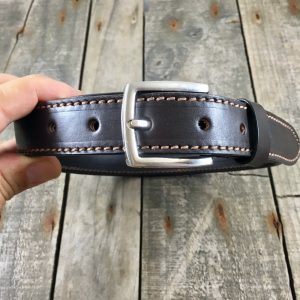
The Essential Leather Belt for the Essential Man!
A$120.00 Select options This product has multiple variants. The options may be chosen on the product page
Getting the size right
This is the part people get wrong, and it is the only thing about ordering a belt that needs care.
Do not order your trouser size. A 34 waist does not mean a 34 belt. The belt has to go around the trousers, through the loops, with your shirt tucked in — so the length you need is bigger than your waist measurement, and by an amount that depends on what you wear it with.
| Method | What to do |
|---|---|
| Best — measure a belt you own | Lay it flat. Measure from the fold at the buckle end to the hole you actually use. That number is your size. |
| If you have no belt | Run a tape through the belt loops of the trousers you will wear it with, dressed as you normally would. Take that measurement. |
| Last resort | Trouser waist plus roughly 5 cm (2 inches). Treat this as an estimate, not a measurement. |
Measure the belt, not yourself. Every belt is cut to your length after you order, so there is no stock size to fall back on if the number is wrong — and no way to add leather back on.
If you are unsure, email before ordering with what you have measured. That is a two-minute conversation and it is far better than a belt that does not fit.
What it is made of
| Leather | Full-grain vegetable-tanned cowhide |
|---|---|
| Thickness | Two strips of 3–4 oz, stitched together |
| Width | 1-1/4 inch (3.1 cm) |
| Colours | 9 leather, 7 thread |
| Length | Cut to your measurement |
Two strips rather than one thick strap. Stitching two lighter pieces together gives a belt that keeps its body without the stiffness of a single heavy slab, and it puts a stitched edge down both sides where a single strap would have a raw one.
1-1/4 inch is the width that fits the belt loops on trousers as well as jeans. The 1-1/2 inch belts sold everywhere are jeans belts, and they will not pass through the loops on most tailored trousers.
Why not kangaroo
Everything else here is kangaroo, and this deliberately is not.
Kangaroo's advantage is strength at low thickness — which is exactly right for a wallet that has to sit flat in a pocket, and exactly wrong for a belt. A belt needs weight and body. It has to hold its shape across your back, take the load of the buckle without stretching, and feel like something. Veg-tan cowhide does that; thin strong leather does not.
Full-grain, and why that matters here more than anywhere
Most belts sold in department stores are bonded leather — offcuts ground up, glued into a strip and coated with a plastic finish that is embossed to look like grain. They are cheap and they crack, peel and split, usually inside two years.
Full-grain means the outer surface of the hide is intact, not sanded flat and stamped to look uniform. It is the densest, strongest layer of the skin, and it is what allows a belt to darken and soften over years rather than break down.
Vegetable tanning uses tree bark tannins rather than chromium salts. Slower, dearer, and the reason the leather develops a patina instead of simply wearing through.
Made in Rockdale, Sydney
Cut, punched, stitched and burnished by hand after you order, to your length and colour. Allow one to two weeks before it posts. Standard postage within Australia is free and tracked.
Common questions
What size do I order?
Measure a belt you already wear, from the buckle-end fold to the hole you use. Not your trouser size. See above.
Can it be shortened later?
Yes — a belt can be cut down and the buckle end redone. It cannot be lengthened. If you are between sizes, err longer.
Will it fit jeans and trousers both?
Yes. At 1-1/4 inch it passes through tailored trouser loops, which the wider jeans belts often will not.
Does it stretch?
Very little. A single-piece full-grain strap holds its length in a way a bonded or split-leather belt does not — sagging and stretching is a symptom of the cheap construction, not of leather in general.
How do I look after it?
Hang it rather than coiling it in a drawer, and let it dry naturally if it gets wet. It needs no treatment in normal use. It will darken; that is the material doing what it should.