Leather Notebook Covers
A cover turns a disposable notebook into something you keep and refill.
These are made from full-grain veg-tan leather — cowhide rather than kangaroo here, because a cover wants body and structure rather than thinness. They’re stitched by hand and sized to standard notebooks and notepads, so when you fill one you buy another insert rather than another cover.
The Banksia takes a standard notebook and can be personalised. The vertical notepad cover holds a flip pad with an inner pocket for loose paper, in standard and large sizes.
Veg-tan leather is the reason these get better with use. It starts pale and firm, and it darkens and softens as it’s handled — a notebook cover carried daily for a year looks nothing like it did new, in the way you’d want.
Choose your leather and thread colour, and add initials or a name if it’s a gift. Made to order, 1–2 weeks.
Showing all 2 resultsSorted by popularity
-
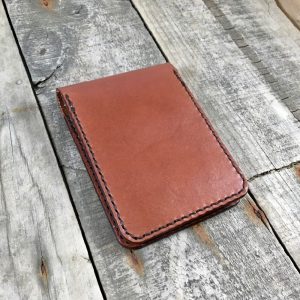
Leather Vertical Notepad Cover, Flip Pad Cover.
Price range: A$60.00 through A$115.00 Select options This product has multiple variants. The options may be chosen on the product page -
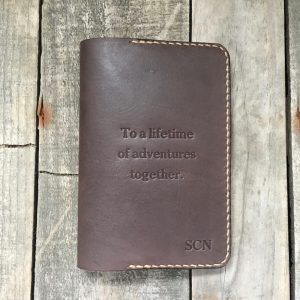
Banksia Personalized Leather Notebook Cover
Price range: A$60.00 through A$85.00 Select options This product has multiple variants. The options may be chosen on the product page
Notebook cover or notepad cover
Two different things, and it is worth knowing which you are after before you order.
| Banksia notebook cover | Vertical notepad cover | |
|---|---|---|
| Takes | A pocket notebook that opens like a book | A vertical pad that flips from the top |
| Fits | Notebooks or passports up to 14 × 9.5 cm — including Moleskine pocket cahiers | Standard pad 9 × 12.5 cm, or large 14 × 22 cm |
| Inside | Sleeves either side to hold the covers | One notepad sleeve, one inner pocket |
| Personalised | Yes — initials or a quote | Yes |
The Banksia is the one most people mean by a notebook cover: a pocket notebook slots in, the cover closes around it, and when you finish the notebook you buy another insert and keep the cover.
The vertical notepad cover is for flip pads — the kind you hold in one hand and write on standing up. It comes in two sizes, and the large one takes a full 14 × 22 cm pad. Tradespeople buy this one.
Refillable by design
Both are covers, not notebooks. The insert is consumable and the leather is not. Fill one, buy another pad, keep the cover.
That is the whole argument for spending money on a cover in the first place: a decent pocket notebook costs a few dollars and gets thrown away three times a year, while a well-made cover accumulates the marks of every one of them.
The leather
These are full-grain vegetable-tanned cowhide, not kangaroo. That is deliberate — a cover wants body and structure so it holds its shape around the insert and stands up to being opened and closed daily. Kangaroo's advantage is strength at low thickness, which is exactly what you want in a wallet and not what you want here.
Veg-tan is why they improve with use. It starts pale and firm, then darkens and softens as it is handled. A cover carried every day for a year looks nothing like it did new, in the way you would want.
Saddle stitched by hand with waxed thread, edges sanded and sealed with beeswax.
Personalisation
Initials, a name, or a short quote, stamped or engraved into the front. This is the piece people most often personalise, and it is usually why they are giving it to someone — a name on the cover is what turns it from a thing someone owns into a thing someone keeps.
Characters go on exactly as typed. Check the spelling; leather cannot be unstamped.
Made in Rockdale, Sydney
Cut and stitched by hand after you order, in your choice of leather and thread colour. One to two weeks, then the post. Standard postage within Australia is free and tracked.
Common questions
Will my notebook fit?
Measure it and check against the table above. The Banksia takes notebooks up to 14 × 9.5 cm, which covers Moleskine pocket cahiers and most similar. If yours is bigger, the journal cover takes up to 21 × 13.5 cm.
Does a notebook come with it?
Sometimes an insert is included — the product page will say. Assume you are buying the cover.
Can it hold a passport instead?
The Banksia will, at that size. If passports are the actual purpose, the passport wallet holds two and has card pockets.
Standard or large notepad cover?
Measure your pad. Standard suits a 9 × 12.5 cm pad; large takes 14 × 22 cm. The large is the one for a proper site or job pad.
How do I look after it?
Use it. Skin oils are what build the patina. It needs no conditioner in normal use, and keeping it out of prolonged soaking is about the extent of the care required.